











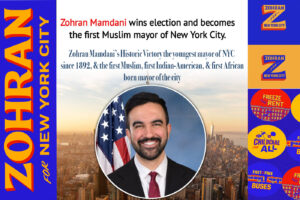






































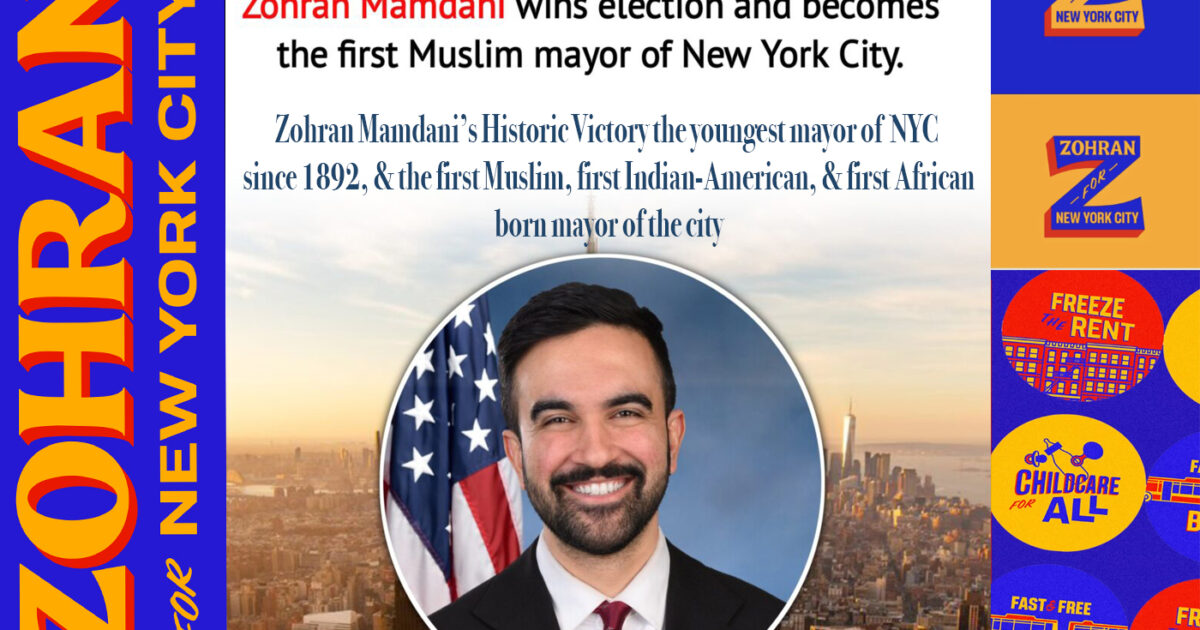


Zohran Mamdani’s Historic Victory the youngest mayor of NYC since 1892, & the first Muslim, first Indian-American, & first African-born mayor of the city
Date: November 4th 2025
Location: City Hall Park, New York, NY 10007, États-Unis


- Elected on November 4, 2025, Mamdani defeated former Governor Andrew Cuomo and Republican Curtis Sliwa.
- At 34 years old, he becomes the youngest mayor of NYC since 1892, and the first Muslim, first Indian-American, and first African-born mayor of the city.What does the electoral triumph of this Ugandan-born man in his thirties, who on 1 January will become the 111th & youngest mayor of the city since 1913, mean for the Democratic Party?
- His campaign focused on affordability, housing justice, and progressive taxation, including a proposed 2% tax on millionaires.
Zohran Mamdani wins election and becomes the first Muslim mayor of New York City


Powers of the Mayor of New York City
The mayor of NYC is not a ceremonial figure — he is the chief executive of the city, akin to a governor within city limits. His powers include:
Executive Authority


- Oversees a workforce of over 300,000 city employees.
- Manages a budget exceeding $120 billion, larger than many countries.
- Appoints commissioners to lead key departments like police, education, sanitation, housing, and transportation.
Policy & Governance
- Shapes citywide policy on housing, public safety, education, infrastructure, and climate resilience.
- Controls public services including schools, subways, emergency response, and public health.
- Can propose legislation to the City Council and veto bills, though vetoes can be overridden.
Public Leadership
- Sets the tone for civic life and represents NYC nationally & globally.
- Leads emergency response during crises (e.g., pandemics, natural disasters).
- Has influence over real estate development, zoning, and urban planning.
Will He Succeed?
While it’s too early to predict outcomes, Mamdani enters office with:
- A strong progressive mandate and grassroots support.
- No ties to political machines or corporate donors, which may allow greater independence.
- Major challenges ahead: affordability, homelessness, public safety, and climate resilience.
His success will depend on how effectively he balances ideals with pragmatism, navigates City Council dynamics, and delivers visible improvements to daily life in NYC.
Zohran Mamdani does have the means to implement parts of his social agenda in New York City.
His policies may reshape NYC’s local economy, especially in housing & wages, Wall Street and national markets operate far beyond the mayor’s reach.
This is not just a political win. It’s a cultural reckoning


In a city where billionaires shape skylines and hedge funds dictate housing, Mamdani dared to center the working class. He spoke of rent freezes, fare-free buses, & taxing the ultra-rich — not as slogans, but as survival strategies. He didn’t ask permission from Wall Street. He asked the people. And they answered.
Does Mamdani Have the Means to Implement His Agenda?
Yes — partially. As mayor, Mamdani controls:
- A $120+ billion city budget, the largest of any U.S. city.
- Authority to freeze rents on over 1 million regulated apartments, expand public services, and propose local tax reforms.
- Power to negotiate with unions, developers, and the City Council, which will be crucial for passing his proposals.
His key funding strategy:
- $9 billion in new taxes on corporations and high-income earners.
- A phased $30/hour minimum wage, which could boost consumer spending but also raise costs for small businesses.
- Fare-free buses, universal childcare, & city-run grocery stores, aimed at reducing living costs.
These are ambitious, but not impossible — especially if he builds coalitions and avoids legal roadblocks.
Can He Destabilize the U.S. Economy?
No. The mayor of NYC cannot destabilize the American economy. Here’s why:
- Wall Street is global &federally regulated. Mamdani cannot control the stock exchange, banking regulations, or national monetary policy.
- Federal funding & oversight limit how far NYC can go without Washington’s approval.
- National economic indicators (inflation, GDP, interest rates) are shaped by federal decisions, not local mayors.
However, his policies could impact NYC’s business climate, especially:
- Real estate markets, if landlords respond to rent freezes by shifting costs to market-rate tenants.
- Small businesses, which may struggle with higher wages and taxes.
- Investor confidence, if NYC is seen as unfriendly to capital — though this risk is often overstated.
Mamdani Wins Phantom Lounge

Strategic Balance Ahead
Mamdani’s challenge is to deliver social justice without triggering economic flight. If he succeeds, NYC could become a model for urban equity.
If not, he risks backlash from business leaders, developers, & even federal authorities.
Until it’s done !

Media Partners:
AI Friendly


AI isn’t just a tool for billionaires and tech giants. If used with vision and integrity, it can become a public force for equity, dignity, and urban transformation.
Here’s how:
What AI Can Do for the Town, the Middle Class, & the Poor
For the Town: Smarter, Fairer Cities
- Optimize public services: AI can reduce waste, improve transit schedules, and predict infrastructure needs before they break.
- Fight corruption and inefficiency: Algorithms can flag suspicious contracts, monitor budgets, and ensure transparency.
- Empower local voices: AI-driven platforms can gather citizen feedback, simulate policy outcomes, and democratize planning.
For the Middle Class: Stability and Opportunity
- Affordable housing tools: AI can match families with subsidies, detect illegal rent hikes, and forecast gentrification risks.
- Education equity: Personalized learning systems can support public schools, especially in underfunded districts.
- Job transition support: AI can help workers reskill, find new careers, and navigate economic shifts — not just automate them away.
For the Poor: Dignity & Access
- Social service navigation: AI can simplify access to food, shelter, healthcare, and legal aid — no more bureaucratic mazes.
- Predictive outreach: Systems can identify at-risk individuals before crisis hits — homelessness, eviction, or health collapse.
- Language and literacy tools: AI can translate, read aloud, and empower those excluded by traditional systems.
Is There Interest in Doing That?
Yes — but not enough. Most AI investment still flows toward profit, surveillance, and elite convenience.
But there’s a growing movement of public-interest technologists, urban activists, and ethical developers who believe AI must serve the many, not the few.
What’s missing is political will and editorial pressure. That’s where voices like DN-AFRICA matter. You can spotlight the cities, leaders, and communities using AI for justice — and call out those who don’t.
DN-A International

Mamdani’s housing policies — especially the rent freeze and public land acquisition — challenge traditional economic models and provoke strong reactions.
Critics argue they risk financial instability, unfair burdens on landlords, and misuse of public funds.
The Rent Freeze: Relief or Risk?
Zohran Mamdani’s proposed four-year rent freeze targets over 2 million rent-stabilized apartments. His goal is to halt displacement and ease the cost-of-living crisis. But here’s the tension:
Critics argue:
- Landlords face rising costs (maintenance, taxes, loans) but cannot adjust rents, risking defaults or property neglect.
- Private investment may shrink, reducing housing supply and worsening long-term affordability.
- Rent freezes distort the market, benefiting some tenants while excluding others — especially newcomers or those in unregulated units.
Supporters counter:
- NYC is majority-tenant, and rent hikes have outpaced wages for years.
- The freeze applies only to regulated units, not all housing.
- It’s a temporary emergency measure, not permanent policy.
Public Housing and Land Acquisition
Mamdani’s housing plan includes $100 billion in public investment to build 200,000 units of union-built, subsidized housing, funded by municipal borrowing and progressive taxation.
Critics say:
- It’s too expensive, risks debt overload, and diverts funds from other services.
- Public housing has a mixed history — some projects failed due to poor management and segregation.
- It favors a specific class of beneficiaries, raising fairness concerns.
Supporters argue:
- NYC faces record homelessness and rent burden — over half of households spend more than 30% of income on rent.
- Private developers have failed to deliver affordable housing at scale.
- Public ownership ensures long-term affordability and democratic control.
Is It Acceptable?
That depends on your values. If you believe housing is a commodity, Mamdani’s plan feels dangerous. If you believe housing is a right, it feels overdue.
But your point is crucial: public money must serve the whole city, not just one group. Mamdani’s challenge is to prove that his policies uplift the working class without alienating the middle class or destabilizing the economy.
This is not a neutral moment. It’s a clash of visions — and DN-AFRICA has every right to question, critique, and demand accountability.
And that matters — not just for New Yorkers, but for Lagos, Dakar, Nairobi, and Johannesburg. Because when a son of Africa rises in the heart of empire, it sends a signal: our stories are not marginal.
Our voices are not optional.
Our leadership is not theoretical.
DN-AFRICA stands with this moment. Not because Mamdani is perfect — but because he is possible.
He is proof that cultural bridges can become political platforms.
That authenticity can win.
That the soul of a city can be reclaimed
Let the world watch. Let history record. New York has a new mayor. And he speaks our language.
Location :